In preparation for giving a talk about "IT for emergency physicians" in Kos in september I stumbled upon a great podcast site, The Toastmasters Podcasts. The Toastmasters club needs no introduction but in case you haven't heard about them:
"Toastmasters International (TI) is a nonprofit educational organization that operates clubs worldwide for
the purpose of helping members improve their communication, public speaking and leadership skills..."
Their podcasts are simply awesome and touch everything you have to know to be a good speaker. Preparation and training is the most important thing you do if you don't want to end up standing in front of your audience with a crimpled tongue and your head full of cotton. Now matter how much you've worked on your slides and notes - if you show up untrained, you WILL fail! So enjoy these great and free podcasts where they feed you full of preparation tips.
June 9, 2011
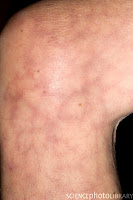
The shocked skin - livedo reticularis or cutis marmorata?
A patient in shock will often have a skin-pattern that is hard to forget. This pattern is also seen in the last hours of a moribund patient and almost always post-mortem. "Mottled skin" is the insider slang; it is commonly described as cold, damp/sweaty, pure white with small patchy islands of purple/pink spots in between. This skin pattern, together with the clinical picture, should bring the doctor to the attention of a true emergency where the patient needs immediate care. Physiologically this phenomenon has been explained by peripheral vasoconstriction, an effect of rush of catecholamines in the blood. The body is in a shocked state and strives to move all volume from the periphery to central spaces. If the patient is awake he will most likely be at unease, confused and agitated because of poor CNS perfusion, catecholamines and even pain.
Initially, the purpose of this blogpost was to entertain the reader (hopefully emergency physician) with the one and only truth about the "mottled skin" since it is a common and frightening sight in the ED but vaguely defined. However, it appears that there is no concrete truth in this case, even major sources (Harrison's online, Merck Manual) are silent as the grave. In the end I found some explanations in on of the two holy bibles in emergency medicine, Rosen's emergency medicine, though in the pediatric section (the other is of course Tintinalli's). I want to belive their description also applies to adults:
is sometimes mentioned along with shock but there are other more common differential diagnoses such as decompression sickness, normal (cold) response in young children and a congenital variant (CMTC). All indicate instability in the vasculature (vasospasm/dilation). The patterns are unfortunately not uniformly defined as seen in the pictures on DermAtlas and NEJM.
is also connected with shock, as in this case in BMJs "Images in emergency medicine" series. It confuses however my view of the phenomenon whereas other sources describe livedo as a common pattern of various well-defined, mostly autoimmune, diseases ranging from benign to acute ischemia of the extremities. The skin pattern is sharper than cutis marmorata and the morphology more reticular, as the name indicates.
So after all the browsing I unfortunately didn't come to any intelligent conclusions; for "mottled skin" in the shocked patient, there is no good definition or specific description and differentiation from other similar symptoms pictures of more benign origin. What is clear (as before!) however is that this is a pattern that all emergency physicians must be aware of as it commonly indicates a disaster on its way.
Initially, the purpose of this blogpost was to entertain the reader (hopefully emergency physician) with the one and only truth about the "mottled skin" since it is a common and frightening sight in the ED but vaguely defined. However, it appears that there is no concrete truth in this case, even major sources (Harrison's online, Merck Manual) are silent as the grave. In the end I found some explanations in on of the two holy bibles in emergency medicine, Rosen's emergency medicine, though in the pediatric section (the other is of course Tintinalli's). I want to belive their description also applies to adults:
Compensated shock can be recognized by the presence of pallor. A pale child with a rapid heart rate should always be considered to be in shock until proved otherwise. As cardiac output is further compromised and perfusion to vital organs is decreased, the skin may become mottled. Mottling is manifested by areas of vasoconstriction and vasodilation in a random pattern on the skin. It reflects loss of small vessel integrity and may be similar to what is seen in vital organs during multiple organ system failure. Mottling is usually an ominous sign. It is important to not confuse cutis marmorata with mottling in young infants [...]. Cutis marmorata is a lacy marbling of the skin caused by vascular instability. It is a normal finding and is commonly seen in infants in a cool ambient environment.
Cutis marmorata
is sometimes mentioned along with shock but there are other more common differential diagnoses such as decompression sickness, normal (cold) response in young children and a congenital variant (CMTC). All indicate instability in the vasculature (vasospasm/dilation). The patterns are unfortunately not uniformly defined as seen in the pictures on DermAtlas and NEJM.
Livedo reticularis
is also connected with shock, as in this case in BMJs "Images in emergency medicine" series. It confuses however my view of the phenomenon whereas other sources describe livedo as a common pattern of various well-defined, mostly autoimmune, diseases ranging from benign to acute ischemia of the extremities. The skin pattern is sharper than cutis marmorata and the morphology more reticular, as the name indicates.So after all the browsing I unfortunately didn't come to any intelligent conclusions; for "mottled skin" in the shocked patient, there is no good definition or specific description and differentiation from other similar symptoms pictures of more benign origin. What is clear (as before!) however is that this is a pattern that all emergency physicians must be aware of as it commonly indicates a disaster on its way.
February 20, 2011
Discussion forums, part 2
Emergency medicine is a very young specialty in Scandinavia and as such we have a lot to learn and discover. Although my ED can proudly claim to be one of the first and most developed in Scandinavia - we still are no more than 30 or so young and enthusiastic residents but without the backup of emergency medicine specialists who've been there for ages and "seen it all". So we have many questions and ponders over clinical and practical aspects of the ED which require that extra experience and cannot be answered internally. Comparison of treatment methods or approach, types and use of ultrasound devices, prehospital involvement just to name a few examples - a discussion forum would be truly useful for sharing thoughts with colleges abroad and having those special questions answered or at least discussed.
Some might have thought Facebook is all we need and surely it would be sufficient if everyone was familiar and comfortable with it's privacy hassle. It turns out doctors are paranoid as cats in the bathtub and I've never been able to engage projects with FB because of this, frustrating as it is. Twitter is another option and with the use of a selected hash-tag, say #em-forum, it should be easy to setup a centralized, simple to use platform. But tweets are limited to 140 characters only and discussions are open to the whole Internet. And then too many doctors don't even have a Twitter account, except for Dr. Bailey who just jumped onboard.
I exchanged my thoughts with the ever hyperproductive LITFL guys and they reminded me of http://www.doctors.net.uk which is essentially a social network (Facebook like) platform where registration is moderated so that there are only doctors signed in. I must admit, I haven't been there for a while but the mere idea of persuading thousands of emergency physicians to register and try it out gives me chills all the way from brainstem down to cauda equina. I actually tried once using the free-and-easy-to-use Ning social-networking platform to engage my colleges - they liked the idea but signup/login treshold and a miniscule learning curve was still enough to kill it in birth. Doctors are busy, conservative (just a polite way of saying IT-lazy) and generally exhausted - everything new needs to be dead simple, easy, ready-to-use and again; dead simple.
That leaves us with only one option, email. Every doctor has an email and reads it on a daily basis or so. A server backup-ed, email based postlist system with functions to moderate content and members would be absolutely necessary. Members would want to have an option to login to change their profile and settings (receive immediately or digested content) and even go back in time and read older posts in the archive. Members should be able to see each others and even contact them individually. The system should still be closed for the public, that is - open for special registration/invitation only.Is this starting to sound like Google Groups? Well, it is. GG is the only system I have managed to use to successfully get together a group of doctors and believe me, I've tried a lot of platforms.
Besides being a tip for you if you wan't to engage your colleges at work for off-work discussions, this will be my attempt to make a unified discussion platform for enthusiastic and alike emergency physicians all around the world. Now that I have colleges in USA, Australia, Iceland, Sweden and UK - this surely has a potential for multicultural emergency medicine discussions. So if you feel interested please feel free to invite yourself at
https://groups.google.com/group/em-physicians
We'll see what this expirement leads to!
February 11, 2011
Dr. Bailey does the Twitter
My wife told me yesterday about an interesting scene in the last episode of Grey's anatomy. It turns out Dr. Bailey was Twittering in the OR for the sake of getting assistance from her social-network. As expected she was met with sceptism and disbelief from the chief who finally though got the catch and accepted this new technology. This short clip says all there is to say about Twitter - and social networking in general. It is bound to make a HUGE impact on the way we practice!
I wonder if the script was based on a true story where a college had difficulties with a patient in severe hypertensive crisis but got help from Twitter?
January 22, 2011
Google custom search to search all your blogs and resources
While everyone of us searches the web for clinical information every day or so I am amazed to see how little physicians bother about the actual search tools or using advanced search queries since these can significantly alter the results in a positive way. It's pretty much like scavenging the ocean floor when looking for birds.
Google has a special "site:" operator to search a particular webisite (URL) or even part of the site only. This will give us even better results than the above mentioned query;
"ileus site:emedicine.medscape.com"
will return results only from Emedicine. This way you can use the power of the Google search engine rather than the sites' own.
You can actually add more site:... operators to search a group of websites but that's making things a bit complicated isn't it? So what if you could search a predefined group of sites only?
Well, Google custom search is exactly that and even more. It's one of the excellent Google tools and as such free and uses your Google account to store your predefined sets of selected searches. Yes, you can define not only one set but as many as you wish. I have been using a "medical community" group where I search my favourite emergency medicine blogs (the 'blogosphere'), perfect for finding my colleges' personal experience and opinions or even updates on clinical matters. Then I have a "basic medical resources" where I have included Emedicine, "Merck manual" and similar webs when I want to do some "back to basics" digging into the medical knowledge.
Subscribe to:
Posts (Atom)